The real question isn’t simply which pays less tax?
£50,000 profit. Sole trader or limited company? There isn’t a clean answer, and anyone who gives you one in a sentence probably hasn’t asked the follow-up questions. How much do you actually need to live on? Is there a PAYE salary sitting alongside this? Is the profit going to stay in the business, or straight into your account?
Small business accountants field this exact question all week long, and it rarely lands the same way twice. Forget the idea that there’s a profit level where incorporating suddenly becomes obvious for everyone. There isn’t. Your numbers decide it. Not some rule from a forum thread nobody’s updated since 2019.
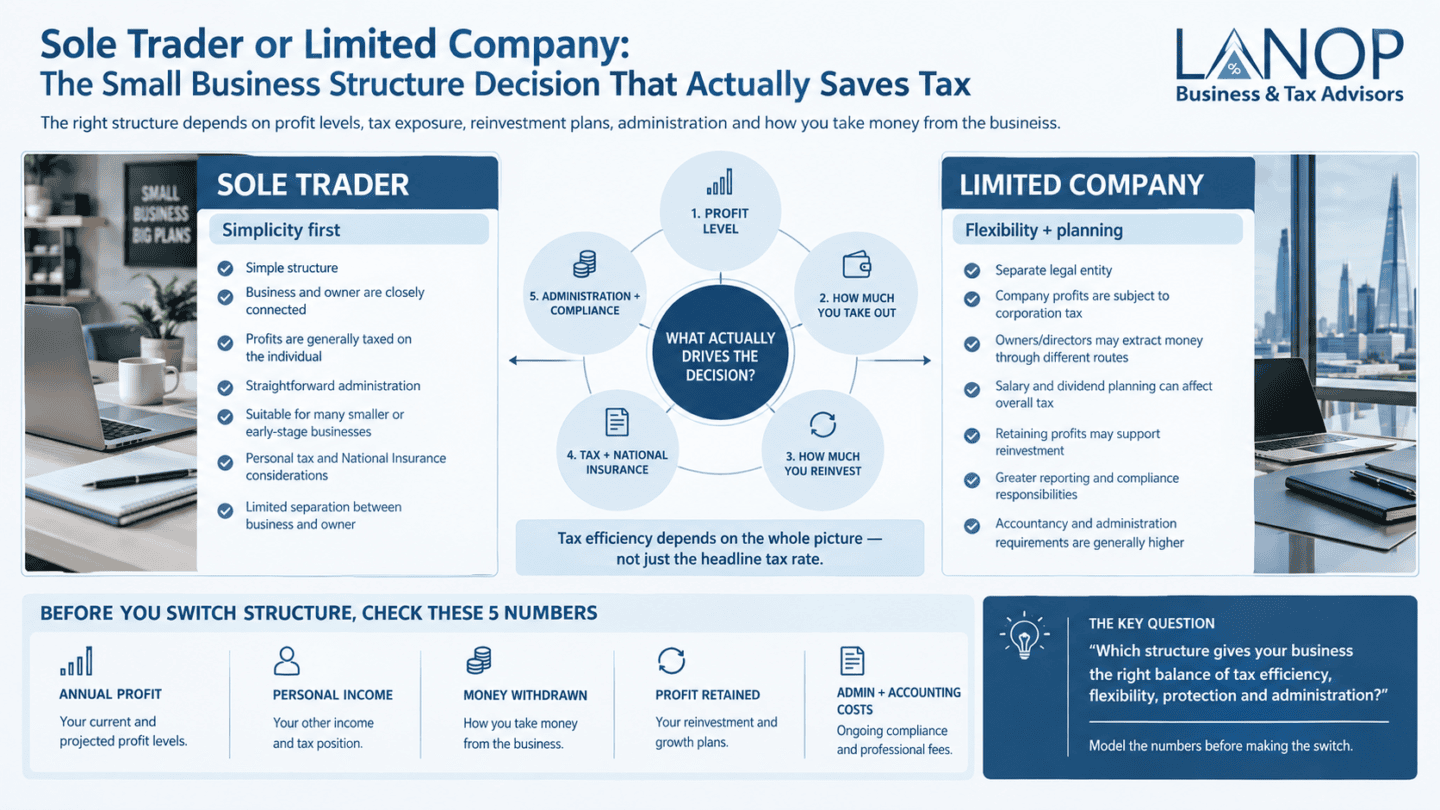
What’s the actual difference?(Sole trader or limited company)
As a sole trader, you and the business aren’t separate. You get taxed personally on whatever the business makes, you keep what’s left, and any debt the business runs up is yours to deal with too.
A limited company splits that apart. It exists as its own legal entity. The company itself pays Corporation Tax, and you take money out through salary, dividends, or a few other permitted routes. That split gives you some protection, sure, but it comes with more filing and a lot more of your business sitting on public record.
| Factor | Sole trader | Limited company |
| Legal identity | You and business are one | Separate legal entity |
| Main tax | Income Tax + NI | Corporation Tax |
| Taking money out | Profits are yours | Salary, dividends, other routes |
| Liability | Personal | Limited, with exceptions |
| Administration | Simpler | More formal |
| Public filing | Minimal | Companies House filings |
GOV.UK confirms as much: the structure you pick shapes your tax bill, your legal responsibility, your record-keeping, and how money actually gets to you.
Does a limited company actually save tax in 2026/27?
Not on its own, no. It comes down to your profit, whatever else you’re earning, how much you’re pulling out, and how much stays parked in the company.
You’ve heard the £40,000 rule somewhere. Hit that figure and the savings just show up, apparently. It gets repeated so often people stop questioning it. But it skips over your personal income completely, what you need to withdraw, and what it actually costs to run a company year after year.
What genuinely changes the outcome? Business profit, obviously. Salary. Dividend tax. Corporation Tax. National Insurance. Whatever profit you’re leaving is retained. Pension contributions too, and accounting fees. Move one of these and the whole comparison shifts under you.
The rates themselves matter. For 2026/27, dividend tax sits at 10.75% for basic rate, 35.75% higher rate, 39.35% additional rate, all above the £500 allowance. Those went up from the year before. So if the numbers you’re working from came from an old blog, you’re already off.
Drop the “Income Tax versus Corporation Tax” framing. It was never that simple. What actually matters is the total cost of running each structure, all in.
How much profit makes a limited company worth considering?
No single number settles this. Where your profit sits, though, changes which questions are worth asking.
Around £20,000 to £30,000, ask whether the business has even found its footing yet. Are profits steady? Do you need nearly every pound personally, right now? If so, company costs can quietly swallow whatever tax benefit you were hoping for.
£30,000 to £50,000 tends to be where people first seriously look at incorporating. Circumstances still call the shots, not the figure. Past £50,000, higher-rate personal tax enters the frame, along with dividend tax and however much you’re planning to retain. Beyond £75,000, pension planning and liability protection start pulling real weight.
And profit that jumps around? £25,000 one year, £45,000 next, £75,000 after that, then back to £40,000. One strong year isn’t reason enough to incorporate. The structure needs to hold up across more than a single lucky stretch.
The biggest tax question:Will you take all the profit out?
Most generic advice falls apart right here.
Need nearly all of it personally? A limited company often won’t hand you the savings you’re picturing. Corporation Tax gets taken first, then personal tax hits again once you extract what’s left. Two bites, same apple.
Leave money inside the company, though, and the picture changes. Retained profit is only taxed at the Corporation Tax rate, meaning it can fund reinvestment or just sit as working capital, no personal tax due until you actually take it out.
Two owners, both on £50,000. One needs nearly all of it just to get by. The other needs £30,000 and can happily park £20,000 in the business. Same profit, same industry, and honestly, a different answer for each of them.
What if you already have a PAYE salary?
£70,000 from a job, another £30,000 from a side business. Worth incorporating?
Your salary already fills the basic-rate band, so the business income lands on top, likely taxed at the higher rate whichever structure you pick. A side income of £10,000-£20,000 probably doesn’t justify the admin of a company. Grow that to £30,000-£50,000, and retaining profit inside a company starts making sense, mainly because it stops everything stacking onto income that’s already taxed hard.
How does money actually leave a company?(Salary or dividends)
Salary goes through payroll. Income Tax and National Insurance apply, and the company gets to deduct it. Dividends work off profit that’s already had Corporation Tax taken out. Past the £500 allowance, dividend tax kicks in at 10.75%, 35.75% or 39.35%, depending where you sit. Not tax-free, whatever you might’ve read somewhere. Just taxed differently, and where you land depends on everything else you’re earning. Most directors blend the two anyway, a modest salary with dividends stacked on top.
What does a limited company really cost to run?
Company accounts. A Corporation Tax return. Bookkeeping. Payroll. Software. Companies House filings. Advice when things get complicated. It stacks up quicker than most people expect.
The quick version: take the potential tax saving, subtract what the company costs to run, and whatever’s left is the real number. Saving looks like £1,000, compliance runs £1,300? That’s not a win. That’s a loss wearing a tax-saving costume.
Is a sole trader still simpler in 2026?
Mostly, yes. There’s a catch, though. Making Tax Digital for Income Tax now covers sole traders and landlords above a certain threshold, meaning quarterly digital updates instead of a single annual return. That doesn’t hand the win to companies automatically. It just means “sole trader equals one simple return” stopped being quite true.
What should you actually do next?
Run through this honestly. What profit do you realistically expect? How steady has it actually been? What do you need to live on? Is there other taxable income already? How much could genuinely stay in the business? How much admin are you willing to take on? And does what you’d gain actually outweigh what it costs?
No calculator online can weigh that against your real numbers. That’s the job small business accountants actually do, running your profit, your extraction needs, and your retained-profit scenario side by side, instead of handing you a rule of thumb and calling it a plan.
Frequently Asked Questions
Is it better to be a sole trader or a limited company?
Depends on your profit level, how much you need to withdraw, and how much you can leave sitting in the business. Higher, steadier profits with some retained earnings tend to favour a company. Lower or bumpier profits usually suit staying a sole trader.
What profit should I make before becoming a limited company?
There’s no fixed threshold, whatever the “£40,000 rule” claims. It comes down to your personal income needs, other earnings, and how much extra admin you can stomach. Two identical profits can still land on different answers.
Does a limited company always save tax?
No. Need to withdraw nearly all the profit personally? The apparent saving often vanishes once accounting and compliance costs get factored in. It tends to only pay off when some profit stays inside the company.
Can I leave profit inside my limited company?
Yes, and this is usually where the real advantage sits. Retained profits get taxed at Corporation Tax rates rather than personal ones until you actually withdraw them. That gap can fund reinvestment without an immediate personal tax hit.
Can I switch from sole trader to limited company later?
Yes, and it’s generally simpler than going the other way. You’ll need to register the company, set up a business bank account, and move contracts, assets and records across properly. Getting that transition right matters more than when you do it.
Conclusion
Four questions, really. How much do you make? How much do you need personally? How much can stay in the business? What’s the structure going to cost you in tax, admin and responsibility?
A sole trader isn’t the automatic “small business” default, and a limited company isn’t the automatic tax-saving move. The right answer sits in your actual numbers, which is exactly the comparison Lanop Business & Tax Advisors works through with business owners before they commit to either one.



Leave a Reply