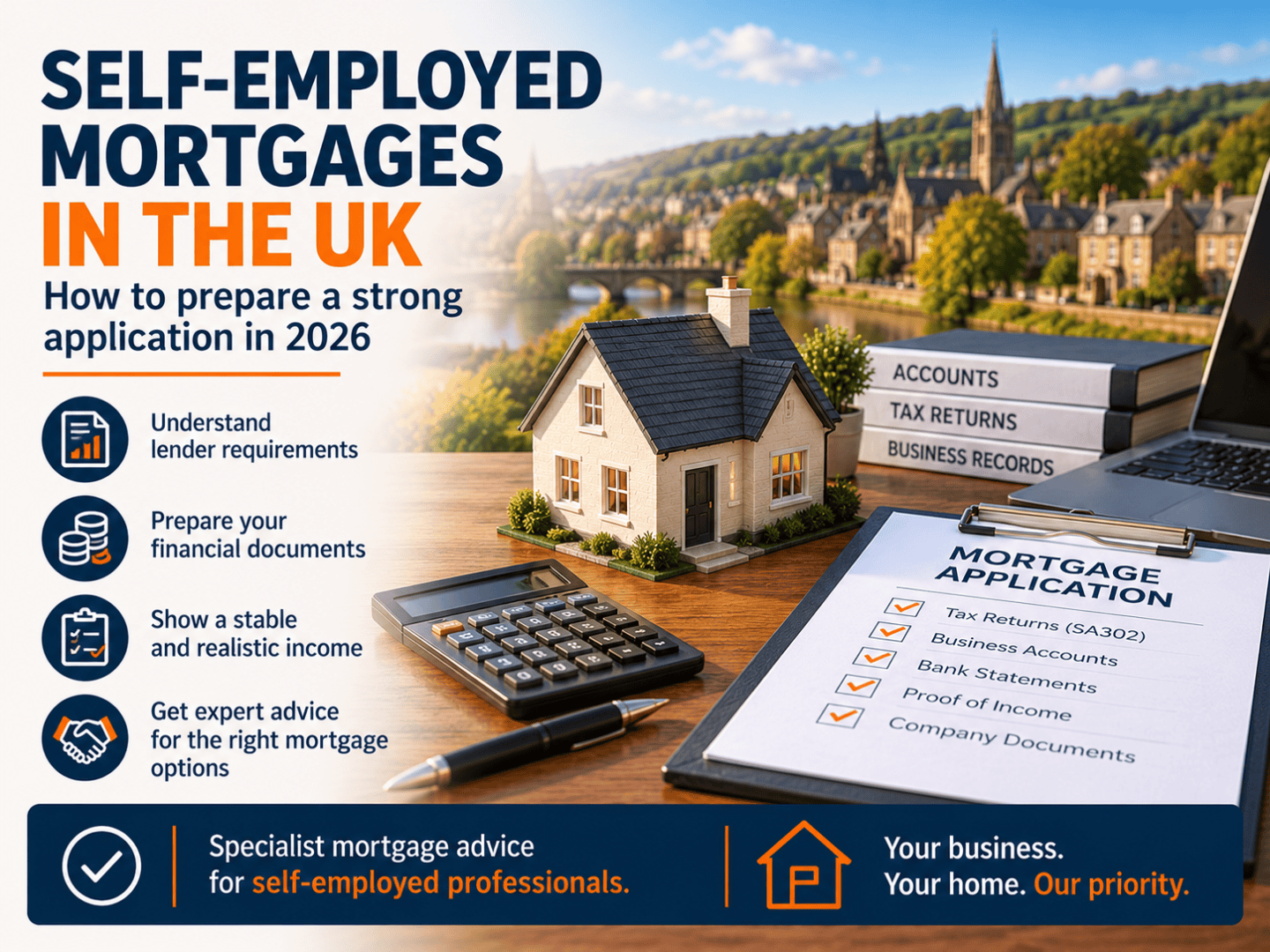
Being self-employed offers flexibility and the opportunity to build a business, but it can make some financial applications more complicated. Mortgage lenders need to establish that applicants have sufficient income to meet repayments, and business owners may not receive the regular payslips that employees use to demonstrate their earnings.
The good news is that self-employed mortgage applicants can obtain mortgages. Preparation, accurate records and an understanding of lender requirements can make the process more straightforward.
Why Can a Self-Employed Mortgage Application Be Different?
For an employee on a permanent salary, a lender may be able to assess income using payslips, bank statements and an employer’s confirmation. A self-employed applicant may have fluctuating income, seasonal trading patterns, business expenses or profits that vary from one year to another.
Lenders therefore need to understand the sustainability of the business and the income available to the applicant.
The evidence required depends on whether you operate as a sole trader, partnership or limited company director. A sole trader’s taxable profits are not assessed in precisely the same way as a director’s salary and dividends.
Some lenders may also consider retained profits in a limited company, subject to their criteria and the applicant’s circumstances. It is important not to assume that every lender will calculate income in the same way.
How Many Years of Accounts Do You Need?
Many lenders commonly request two or three years of accounts or tax information, but requirements vary. Some may consider applicants with a shorter trading history where the wider circumstances and evidence meet their criteria.
Typical documents include:
- SA302 tax calculations and tax-year overviews.
- Business accounts prepared by a qualified accountant.
- Personal and business bank statements.
- Evidence of current contracts or ongoing work, where relevant.
- Details of business debts and regular expenses.
- Identification and proof of address.
- Information about existing personal borrowing.
The lender may ask for additional documentation if income has changed significantly or if the figures in the accounts do not match the amounts received into bank accounts.
Keep your records organised and ensure that the information you provide is consistent. Accurate documentation helps a lender understand your circumstances and reduces the likelihood of avoidable delays.
How Is Self-Employed Income Calculated?
There is no single calculation used by every mortgage lender.
For a sole trader, a lender may focus on net profit rather than total business turnover. For a limited company director, it may assess salary and dividends, or consider other eligible measures of income under its policy.
If your business profits have increased over time, a lender may use the latest year or an average of multiple years. If profits have fallen, the lender may need to understand why and whether the reduction is temporary or likely to continue.
For example, a business owner might report a strong year followed by lower profits because of increased costs. The lender will need evidence to assess the current position rather than assuming that the strongest historical figure will continue.
This is one reason why an initial borrowing estimate should not be treated as a guaranteed offer.
Does a Short Trading History Prevent You From Getting a Mortgage?
Not necessarily. A shorter trading history can reduce the number of suitable lenders, but it does not automatically mean an application will fail.
Some lenders may consider an applicant who has recently become self-employed if there is relevant experience in the same industry, a credible explanation for the change and evidence of current earnings. Others may require a longer period of accounts.
Contractors and freelancers may face different questions depending on whether they operate through a limited company, work under fixed-term contracts or receive income from several clients.
Before making an application, explain your business structure and work history clearly. A mortgage adviser familiar with self-employed cases may help identify lenders whose criteria fit your circumstances.
Improve Your Financial Preparation
There are several practical steps that may improve the quality of your application.
Separate business and personal finances. Dedicated accounts can make income and expenditure easier to understand, although the lender may still request both personal and business statements.
Keep tax affairs up to date. Ensure tax returns and payments are accurate. If you have outstanding tax liabilities, understand how they affect your available income and affordability.
Reduce unnecessary borrowing. Credit cards, personal loans, car finance and other commitments can affect the amount a lender considers affordable.
Avoid unexplained transactions. Large deposits or transfers may require evidence of their source. Keep records for savings, gifts and business-related payments.
Speak with your accountant. Accurate accounts and a clear understanding of your income can help you prepare the documents lenders need. Do not manipulate business figures simply to obtain a mortgage.
Review your credit report. Correct any errors before applying and make sure existing credit commitments are accurately disclosed.
These steps cannot guarantee approval, but they can make the financial picture clearer.
Understand Affordability and Deposit Requirements
The size of the deposit affects the loan-to-value ratio and may influence the range of available products. A larger deposit can sometimes improve access to competitive rates, but it is important to retain sufficient savings for emergencies and business expenses.
Mortgage affordability also depends on personal expenditure, existing debt, household costs and the stability of income.
Self-employed borrowers should also test whether repayments would remain manageable during a quieter trading period. A mortgage that is affordable only when business income reaches its highest level may create unnecessary financial pressure.
Book an appointment with us.
What Has Changed in 2026?
The mortgage market remains sensitive to interest-rate expectations and economic uncertainty. The Bank of England held Bank Rate at 3.75% at its September 2026 meeting, while market reporting in October showed that fixed mortgage pricing had experienced renewed pressure.
Rates offered to self-employed applicants depend on the same broad market factors as other residential borrowers, as well as the applicant’s deposit, credit history and chosen lender. Specialist products may have different rates or fees, so compare the overall cost rather than assuming that a specialist option will be cheaper.
The Financial Conduct Authority announced proposals in June 2026 intended to help more people access mortgages, including some self-employed applicants and borrowers with variable income. These proposals should not be mistaken for a universal rule change or a guarantee that every lender will accept a particular income type. Check the current position and individual lender criteria.
When Should You Seek Mortgage Advice?
Consider seeking advice before making an offer on a property, especially if your income fluctuates, your company structure is complicated or you have been trading for less than two years.
Prestige Mortgage Solutions Ltd advertises mortgage support for self-employed applicants and people with more complex income circumstances. When choosing an adviser, ask which lenders can be considered, what documents are required, how the adviser is paid and whether any fee applies. Confirm the firm’s current regulatory status and permissions through the FCA register.
An adviser should help you understand the available options without promising approval before a lender has assessed your case.
Final Thoughts
Self-employed applicants can improve their mortgage preparation by maintaining accurate accounts, understanding how lenders assess income and organising their paperwork before applying.
The most important step is to present a realistic and well-documented picture of your finances. With the right preparation and suitable advice, you can explore mortgage options that reflect how your business actually operates.
This article is for general information only and does not constitute mortgage, legal, tax or financial advice. Lender criteria and mortgage availability vary. Your home may be repossessed if you do not keep up repayments on your mortgage.



Leave a Reply