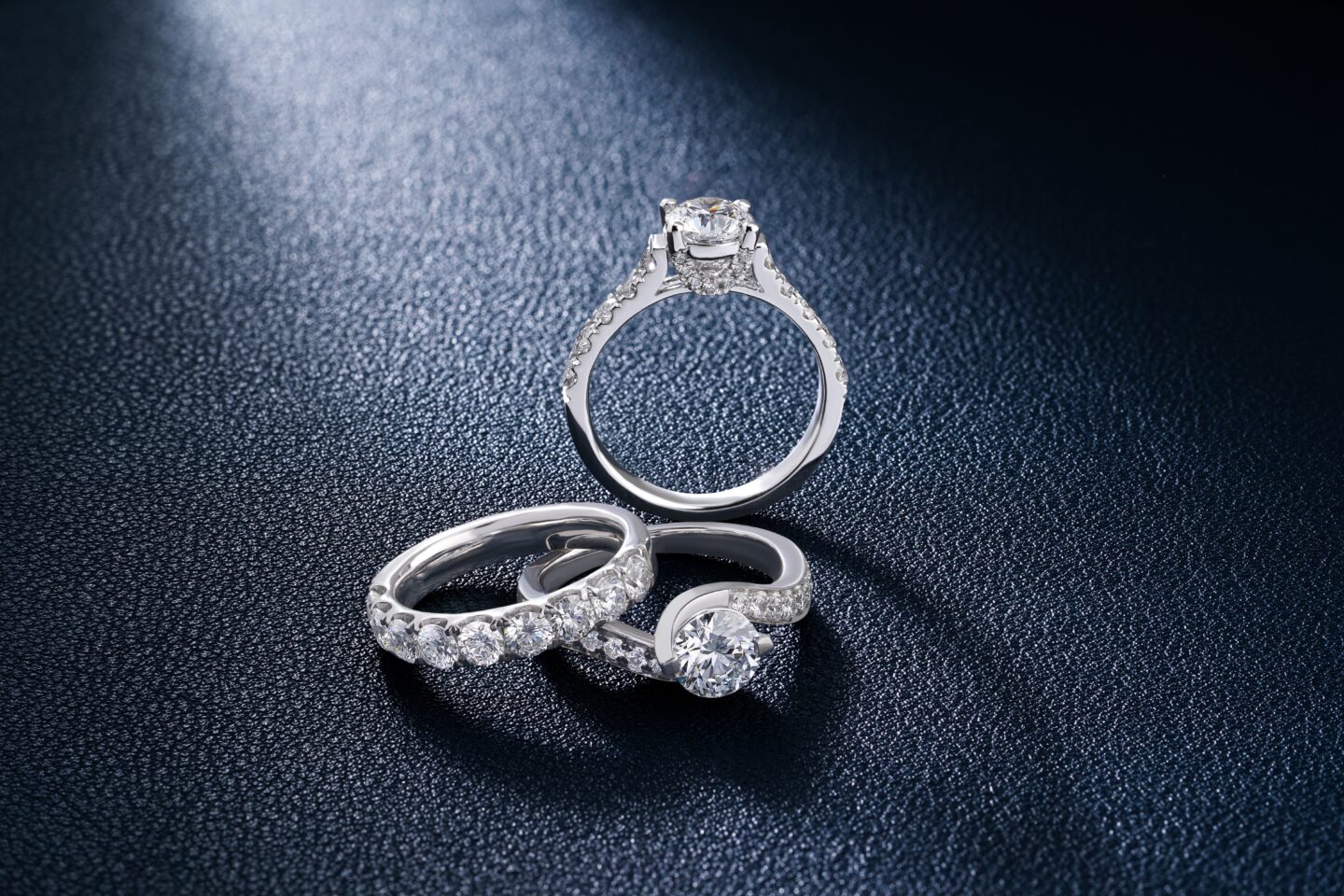
A comparison of the three styles couples most often weigh up, from the light a diamond gives back to the tiny beads of metal that hold it
Under the low, amber lighting of a restaurant, a ring that looked dazzling in the jeweller’s window can look oddly flat. Jewellers light their counters with strong spotlights, and diamonds answer that kind of light with flashes of white and colour that a lamp over a dinner table rarely draws out. Some ring styles cope with the change of scene far better than others.
The choice tends to narrow to a single stone on a band, a centre stone ringed by smaller diamonds, or a band covered in tiny stones set side by side. Each handles light in its own way, and each ages differently on the hand. Much of it comes down to the cut of the stone and the hand of the setter, and only the first can appear on a grading report.
Pavé and micro pavé, where the metal almost disappears
A pavé band is made of small diamonds set in rows so close together that the surface reads as a strip of light, and in micro pavé the stones are smaller still. Each one sits in a seat cut into the metal and is held by tiny beads raised from the metal between neighbouring stones. A single small diamond gives off little fire, yet dozens of them catching the light at slightly different angles keep a pavé band glittering when the room is dim.
Work at this scale is done under magnification. A bead raised too thin, or pushed at the wrong angle, can look perfect on the day the ring is sold and still let a stone go months later, and the flaw may be invisible to the naked eye. Setting of this kind takes hundreds of hours at the bench to learn, so schools that teach it as a trade of its own build their courses around microscope time. In Rome, the Microscope Stone Setting Course of the Accademia delle Arti Orafe teaches pavé and micro pavé alongside bezels and claws, with trinocular microscopes at the bench from the first exercises.
Is a halo simply a way to make the centre stone look bigger?
Partly, and there is nothing wrong with that. A halo surrounds the centre stone with a frame of small diamonds, often pavé-set, so that from across a table the eye reads the cluster as one larger stone. Because diamond prices climb steeply with carat weight, a modest centre stone inside a halo can cover the same area as a much heavier solitaire for less money.
The frame brings its own upkeep, since every small stone in a halo needs the same checks as a pavé band. The raised head also snags on jumpers and gloves more readily than a low, plain setting.
Why the solitaire leaves the cut with nowhere to hide
A single diamond on four or six claws has no frame to borrow light from, so the cut does almost all of the work. According to GIA’s overview of how diamond cut affects brightness, fire and scintillation, a well-cut diamond is brighter than a poorly cut one of the same size, colour and clarity. The institute’s cut grading system, introduced in 2005 for the round brilliant, sorts stones into five grades from Excellent to Poor and marks down those carrying excess weight in extremely thick girdles, steep crowns or deep pavilions.
The setter matters here as well, if less visibly. Heavy claws cover more of the stone than they need to, while a bezel, the collar of metal wrapped around the whole edge, protects better and lets in a little less light from the side.
Daily wear and the resizing question
A solitaire on a plain band is the easiest ring to live with, because a jeweller can cut the back of the shank and add or remove a little metal without going near the stone. A band with pavé only across the top can be adjusted the same way within limits, since bending the metal close to the stones can loosen them.
The eternity band, with stones running all the way round, leaves no plain section to cut. A full eternity band generally cannot be resized, so the size has to be right when ordering, with some allowance for fingers that swell in summer.
Frequently Asked Questions (FAQ)
Why do small diamonds fall out of pavé engagement rings, and can they be replaced?
Most losses follow a knock that flattens or lifts one of the beads, or years of wear that thin the metal. A jeweller can set a matching replacement, and a yearly check under magnification picks up loose stones before they go.
Can a pavé or eternity engagement ring be made bigger or smaller?
Rings with pavé on the upper half alone can take a modest change of size. Full eternity bands are normally remade in the new size instead.
Is a halo engagement ring cheaper than a solitaire that looks the same size?
In most cases yes, since several small diamonds around a smaller centre cost less than one large stone of similar spread, though the extra upkeep eats into the saving over time.



Leave a Reply