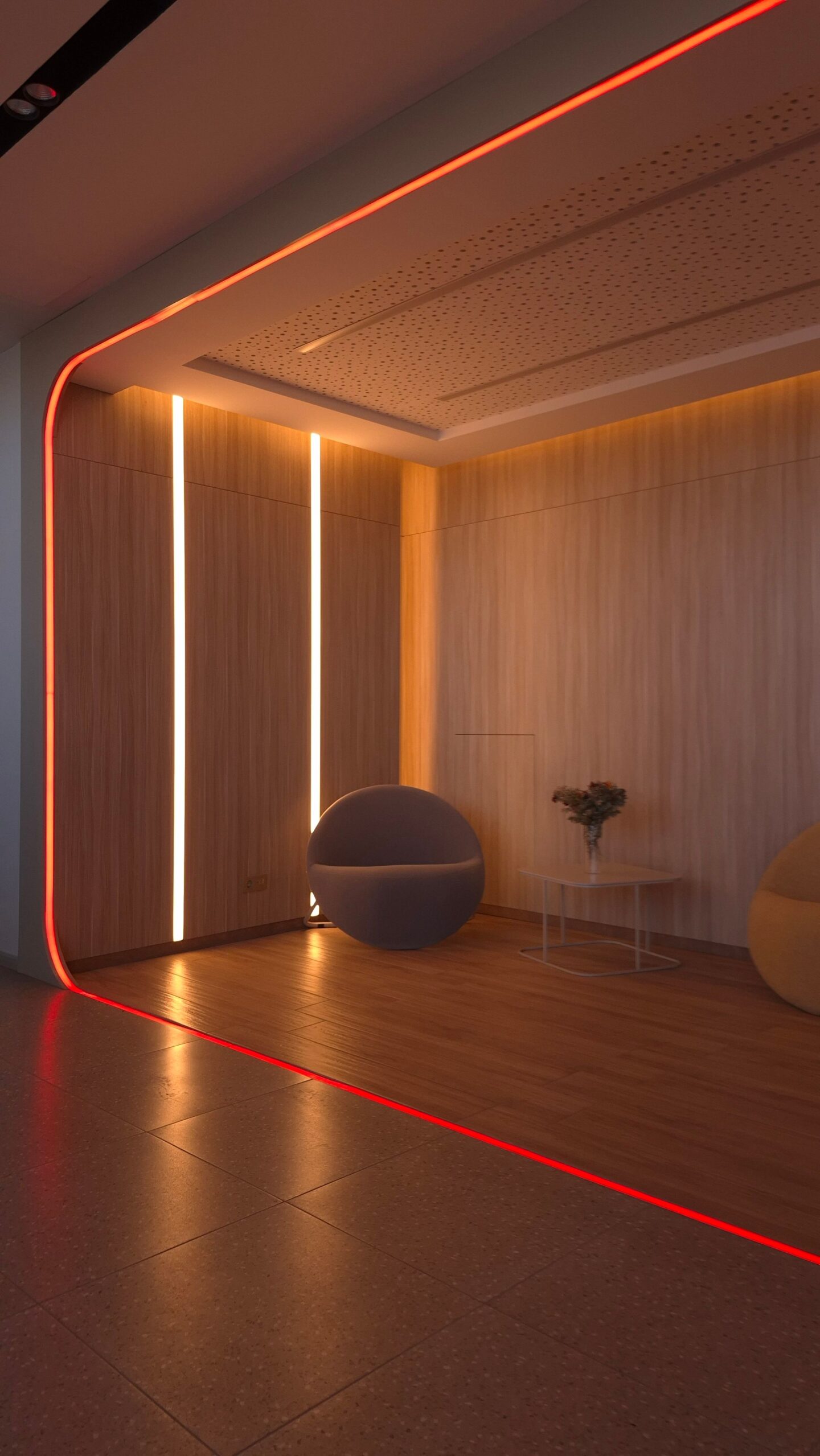
LED strip lights are one of the easiest ways to change how a room looks and feels. A thin line of light tucked behind a shelf, under a cabinet or along a ceiling edge adds depth, hides the bulbs and tells the eye where to look first, all without rewiring a single wall light.
This guide goes room by room, with tips on where to fit the strip, which colour to pick and how to power it safely.
Quick pick: where to fit strip lighting:
| Room | Where to fit it | Suggested colour |
| Living room | Ceiling cove, behind the TV | Warm white 2700K to 3000K, neutral white behind a TV |
| Bedroom | Headboard, ceiling cove, under the bed | Warm white 2700K |
| Kitchen | Under wall cabinets, plinths | Neutral white 3500K to 4000K |
| Bathroom | Mirror, shelf (zone rules apply) | Warm to neutral white, 3000K to 4000K |
| Shelves and alcoves | Behind the front lip, inside the alcove | Match the room |
| Stairs and hallway | Under stair nosings, along skirting | Warm white 2700K to 3000K |
How Can You Use LED Strip Lights in Every Room?
LED strip lights work best as a second layer of light beside your main ceiling light, not as a replacement for it. Pick one or two spots per room and light them well, rather than outlining everything.
Living Room Coving and TV Backlighting
Fit the strip in a ceiling cove or behind the TV to add soft light without glare. A strip behind the TV lights the wall instead of the screen, which softens the contrast between a bright picture and a dark wall.
- Eye comfort: many people find it easier on the eyes in the evening, although the evidence is mostly anecdotal.
- Colour: AV guides often suggest neutral white (about 6500K) to match the screen, while warm white feels cosier.
- Brightness: keep it dim, like a soft halo.
Bedroom Headboard and Ceiling Cove
A warm white strip behind a headboard or in a ceiling cove gives a calm, hotel-style glow.
- Colour: choose 2700K warm white.
- Control: add a dimmer so you can lower the light at night.
- Night light: a strip under the bed frame lets you cross the room without switching on the main light.
Kitchen Under-Cabinet and Plinth Lighting
A strip under your wall cabinets lights the worktop where you chop and cook, so you stop working in your own shadow. Fit it near the front edge, hidden behind a small lip so the strip stays out of sight.
- Product: choose dry-area under-cabinet lighting.
- Keep it dry: keep it away from the sink and hob steam unless the strip has a suitable rating.
- Plinths: a strip along the plinth adds a soft glow at floor level.
Bathroom Mirror and Shelf Lighting
A strip around a mirror or under a shelf gives even, flattering light, but bathrooms follow zone rules. Work near water is a job for a qualified electrician.
- Zone 0 (inside the bath or shower): at least IPX7 and low voltage.
- Zones 1 and 2 (above the bath or shower up to 2.25m, and the band around it): at least IPX4.
- Power supply: it must sit outside these zones.
Shelves, Alcoves and Media Walls
A strip hidden behind the front lip of a shelf, or inside an alcove, makes a display glow without showing the light source.
- Hide the source: fit the strip behind the lip or inside a diffuser channel.
- If it will show: choose a dot-free COB strip.
- Why it matters: otherwise you may see a row of bright dots reflected in glossy surfaces.
Staircase and Hallway Lighting
A strip under each stair nosing, or along a skirting line, lights the steps without glare and makes night-time trips safer. Keep the light low and even.
- Placement: under the nosing or along the skirting line.
- Power: decide where the power supply will sit before you start, since stairs make long cable runs awkward.
Which Colour Temperature Suits Each Room?
Warm white (2700K to 3000K) suits living rooms and bedrooms, neutral white (3500K to 4000K) suits kitchens and task areas, and cool white (5000K and above) suits garages and workspaces. Colour temperature changes how the light feels, not how bright it is.
- Keep it consistent: use one or two temperatures across rooms that open onto each other, since 2700K next to 4000K can look mismatched.
- Want to change the mood? The RGBW strip has a dedicated white channel as well as colours, and needs a controller.
How Do You Power and Fit Strip Lighting?
LED strip lights run on low voltage, usually 12V or 24V, so they need a driver that converts mains power to the right voltage. Match the driver to the strip, and choose one with at least 20 percent spare capacity above the total strip wattage.
- Measure each run and add up the strip wattage.
- Choose a driver with the same voltage and 20 percent spare capacity.
- Clean the surface well, and use an aluminium profile on longer runs to help the strip stay cool and look neater.
- Cut the strip only at the marked cut points.
- Connect everything and test it before you fix the strip in place.
- Fix the strip, then tidy and hide the cables.
Never switch the strip on while it is still coiled, because the heat can’t escape. For dimming, use a dimmer that suits your driver, since leading-edge dimmers can cause flicker. On long runs, wire each section back to the driver separately, since one long chain can leave the far end dimmer.
Common Mistakes When Styling with Strip Lighting
- Visible hot spots: bright dots on shiny surfaces. Use a dot-free strip or a diffuser.
- Mixed colour temperatures: warm and cool white side by side look uneven.
- An undersized driver: a driver running flat out gets hot and fails sooner.
- Dirty or freshly painted surfaces: the adhesive won’t hold, so clean first and let new paint cure.
FAQs
Can I cut the LED strip to size?
Yes, but only at the marked cut points. Cutting anywhere else will stop that section from lighting up.
Do LED strip lights need a driver?
Most do. A driver turns mains power into the low voltage the strip needs. Small USB-powered kits can run from a USB port, which suits a TV or desk but not long runs.
Can I use strip lighting in a bathroom?
Yes, if the strip’s rating suits the zone and the power supply sits outside the wet zones. Ask a qualified electrician to check anything near the bath or shower.
Are strip lights good as the main light in a room?
They work best as accent light beside a main light. On their own, they usually leave a room too dim for reading or cooking.
About the author: Haseeb Faiz writes about lighting for ATOM LED, a UK supplier of LED strips, neon flex, profiles, controllers and drivers.



Leave a Reply