AI-generated editorial illustration; not a specific Latham’s product
Pick a front door by its looks and you can end up with the wrong material for your house. A south-facing door painted black behaves differently in July from a north-facing one. A listed cottage has different rules from a 1990s semi. And a door on a quiet lane needs different security from one on a busy street.
The four materials sold for UK front doors each have a clear profile. Here’s how they compare on the things that matter after the first year: security, insulation, movement, upkeep and price.
The quick comparison
| Steel | Composite | Timber | Aluminium | |
| Security evidence | Check model certification | Check model certification | Check model certification | Check model certification |
| Thermal performance | Check whole-door U-value | Check whole-door U-value | Check whole-door U-value | Check whole-door U-value |
| Movement in heat | Depends on design/exposure | May bow with uneven heating | Swells and shrinks with moisture | Depends on design/exposure |
| Maintenance | Low | Low | Regular | Low |
| Period looks | Panelled and cottage styles | Wide range | Most authentic | Mostly contemporary |
Steel: insulated construction and security options
Steel doors use a steel skin, usually galvanised against rust, over an insulating core. Some steel doorsets hold PAS 24 or LPS 1175 certification, but resistance depends on the complete doorset, its tested rating and its installation.
Insulation is better than many people expect. Latham’s Steel Doors, for example, lists its residential high security front door, a 63mm insulated leaf with galvanised steel skins, a polyurethane foam core and an LVL/uPVC sub-frame, at a U-value below 1 W/m²K. Its specification table declares 0.9 W/m²K; confirm the value for the size and glazing you choose. Steel doors now come in six-panel and cottage styles as well as flat contemporary designs.
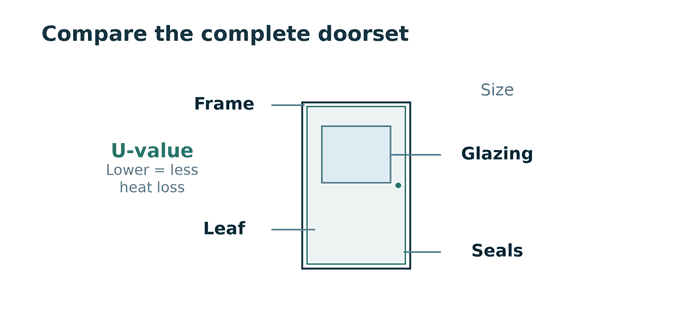
Use the declared whole-doorset U-value for your chosen size and glazing. A material label or leaf thickness alone cannot establish thermal performance.
Downsides: steel can dent on heavy impact, and the range of traditional mouldings is narrower than timber. Cheaper steel doors made for sheds and garages are a different product, so don’t compare their prices with a residential front door.
Composite: the all-rounder
A composite door has a glass-reinforced plastic (GRP) or ABS skin over a core of foam or solid timber, with a reinforced inner frame. It offers a wide style choice, low maintenance and, on certified models, PAS 24 and Secured by Design credentials. Solid timber-core doors such as Solidor’s (44mm core, 48mm overall) feel heavier and more solid than foam-core doors.
Insulation is good. Typical U-values for composite doors are around 1.2 to 1.5 W/m²K, and some brands claim lower.
Downsides: thermal bowing. Manufacturers acknowledge that strong sun on one face of a door, especially a dark door facing south, can cause warping or bowing over time. If your door gets full afternoon sun, ask the maker about lighter colours or construction designed to limit movement.
Timber: the most authentic, the most upkeep
For a Georgian townhouse or a listed cottage, timber is often the right answer, and sometimes the only one your conservation officer will accept. Good joinery can be very secure when built with a steel reinforcement or a certified lock, and some bespoke timber makers test their doors to PAS 24.
Downsides: timber moves with moisture and needs repainting or re-oiling. An uninsulated solid timber leaf can lose more heat than a modern insulated doorset. The government’s SAP methodology uses a default U-value of 3.0 W/m²K for a solid wooden door, though modern engineered timber doors do much better. For any replacement, ask your fitter to confirm the current thermal-performance requirements and any relevant exemptions.
Aluminium: thermally broken frames, contemporary looks
Modern aluminium front doors use thermally broken frames and thick insulated panels. Some premium models publish very low whole-doorset U-values. Spitfire, for example, quotes figures as low as 0.6 to 0.77 W/m²K on its premium ranges. They’re stable in heat and come in sleek, flush designs with long pull handles.
Downsides: price, and a mostly contemporary look. Security varies by model, so ask whether the specific door is PAS 24 certified.
Which lasts longest?
Material alone does not establish a door’s lifespan. Three practical factors to assess are:
- Fitting. A poorly fitted door drops, sticks and leaks whatever it’s made of.
- Exposure. Sun and driving rain shorten the life of finishes and seals.
- Hardware. Locks, hinges and seals wear out long before a good door slab does.
Ask about the finish, corrosion protection, movement allowance and maintenance schedule for the actual product. Exposure and installation can matter as much as material.

Fitting, exposure, hardware and maintenance affect service life. Follow the product-specific care instructions and check finish and component warranty terms.
What it costs
Costs vary more within each material than between them. As a guide, Checkatrade’s 2026 cost guide puts a solid composite front door at £1,100 to £1,400 fitted and a basic timber door from £550 (Checkatrade door installation costs). High-end bespoke timber and aluminium doors routinely cost several thousand pounds. Residential steel security doors sit in the mid range. Latham’s front doors start at £1,399.99 including VAT, supply only.
The short answer
- Security first: a doorset with certification suitable for your needs, with the specified frame, glazing and hardware.
- Period or listed home: timber, or a heritage-style steel or composite door if the planners allow.
- Low heat loss: compare verified whole-doorset U-values for the chosen size and glazing.
- South-facing and dark: check the manufacturer’s exposure and colour guidance before choosing.
Where this comes from
This comparison draws on published manufacturer specifications (Latham’s Steel Doors, Solidor, Spitfire and others), the government’s SAP 10.2 methodology, Approved Document L for U-value limits in England, and Checkatrade’s 2026 cost guide, all checked in October 2026. Figures such as “typical composite U-values” are ranges from manufacturer and installer sources, not independent tests.
Product and source documents: Latham’s; Latham’s 2; Latham’s 3; Latham’s 4; Latham’s 5



Leave a Reply