As my skin has changed, I’ve realised that the makeup techniques I relied on years ago don’t always give me the same result anymore.
It isn’t that makeup suddenly stops working on mature skin. Far from it. I’ve actually found that a few small changes can make an enormous difference.
These days, I’m much less interested in covering every little line or creating a completely flawless base. I want my makeup to make my complexion look fresh, healthy and polished without feeling heavy.
And surprisingly, achieving that usually means doing less, not more.
Here are seven simple tweaks I’ve found can make mature skin look softer, smoother and beautifully put together.
1. Spend More Time Preparing the Skin
If I had to choose between spending an extra five minutes on skincare or an extra five minutes applying foundation, I’d choose skincare every time.
Foundation tends to exaggerate whatever is underneath it.
When my skin feels dry, foundation looks dry. If I have flaky patches, adding more foundation rarely hides them — it usually makes them considerably more noticeable.
I like to start with gentle hydration and give my moisturiser a few minutes to settle before moving onto makeup. Around the eyes, I’m particularly careful not to overload the area with rich products because too much skincare underneath concealer can sometimes encourage it to move around.
The aim isn’t to make the skin slippery.
I simply want it to feel comfortable, plumped and properly hydrated before I start applying makeup.
2. Apply Makeup in Thin Layers
One lesson I wish I had learned earlier is that more coverage doesn’t necessarily create smoother-looking skin.
Quite often, the opposite happens.
A thick layer of foundation might initially hide pigmentation or redness, but after a few hours it can begin collecting around expression lines and textured areas.
I now prefer applying a very thin layer first.
Then I step back and look at my complexion before deciding whether I actually need more.
Usually, I’ll add a tiny bit of extra foundation or concealer only around areas where I have uneven tone rather than applying another full layer across my entire face.
Less product, placed strategically, nearly always looks better on me than trying to create perfect coverage everywhere.
3. Be Extremely Selective With Powder
Powder isn’t the enemy of mature skin.
Too much powder, however, can be.
I used to automatically powder almost my entire face because that was simply part of doing my makeup. Now I ask myself where I actually need it.
For me, that tends to be around the sides of my nose, a little through the centre of my forehead and occasionally beneath the eyes.
My cheeks often don’t need powder at all.
Leaving some areas naturally luminous helps prevent the complexion from looking completely flat and can make the skin appear much fresher.
When I do use powder, I prefer taking a small fluffy brush and pressing on an almost invisible amount rather than repeatedly sweeping it across the skin.
You can always add another touch later.
Removing too much powder once it has settled into your makeup is considerably harder.
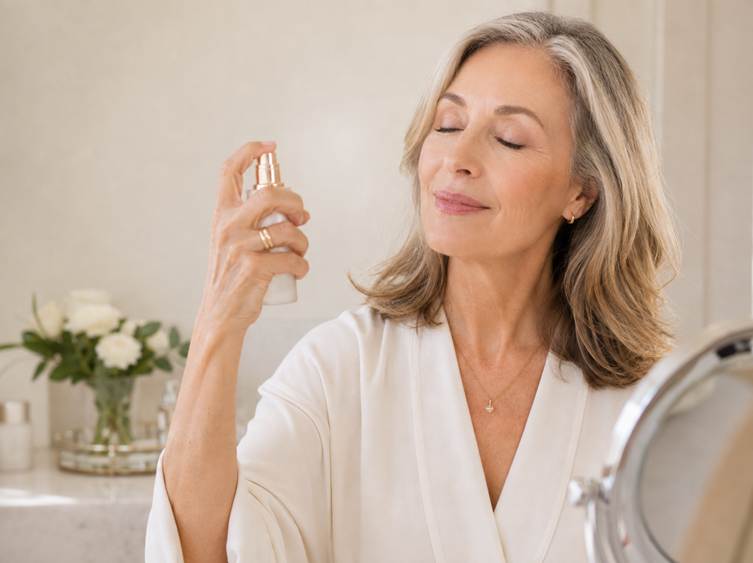
4. Use Setting Spray to Bring the Skin Back to Life
This has become one of my favourite little makeup tricks.
After applying foundation, concealer, blush and any powder, sometimes everything can look slightly too perfect.
You know that freshly-made-up appearance where you can clearly see makeup sitting on the skin?
A light mist of setting spray can help the different layers appear more blended together.
For mature or drier complexions, I tend to favour formulas that leave the skin comfortable rather than intensely matte. I’ve found some excellent setting sprays for mature skin that help keep makeup looking fresh without leaving the complexion feeling tight or overly powdered.
I normally mist lightly from a reasonable distance and then leave my face alone while it dries.
No rubbing. No immediately adding another layer of powder.
Once everything has settled, I find the finish often looks much more like skin again.
5. Move Your Blush Slightly Higher
Blush placement is one of those seemingly tiny details that can completely change the overall appearance of makeup.
For years, many of us were taught to smile and apply blush directly onto the apples of the cheeks.
There’s nothing inherently wrong with doing that, but I now prefer starting slightly higher.
I place most of the colour across the upper cheek and gently blend it towards the temple.
I find this gives the face a fresher appearance while still looking completely natural.
Cream and liquid blushes can be particularly lovely when I want that soft, healthy finish, although a finely milled powder blush can work beautifully too.
The biggest lesson for me has simply been not to use too much.
I start with considerably less than I think I need, blend it thoroughly, and then decide whether I want another touch.
If blush placement is something you struggle with, this guide on how to apply blush on mature skin shows how small changes in placement can create a softer, more lifted effect.
6. Stop Trying to Hide Every Line Around the Eyes
This one took me a while.
The instinct when we notice more darkness or fine lines underneath our eyes is often to add more concealer.
Then perhaps another little layer.
And then some powder to stop everything moving.
Before we know it, the area we were trying to improve has become the most heavily made-up part of the face.
I’ve found that using a tiny amount of concealer strategically works much better.
Rather than covering the entire under-eye area, I concentrate on whichever areas actually look dark — usually towards the inner corner — and blend the product out.
I also avoid trying to completely eliminate every shadow.
Natural faces have dimension.
The objective is simply to look brighter and more rested, not as if somebody has digitally removed my under-eye area.
7. Add Glow Strategically Rather Than Everywhere
There’s a big difference between healthy-looking luminosity and covering the entire face in highlighter.
I love a little glow on mature skin, but I’m selective about where I put it.
Rather than sweeping shimmer across areas where I have more visible texture, I prefer creating luminosity through hydrated skincare, a natural-finish foundation and cream cheek products.
If I do use highlighter, I keep it subtle.
A small amount towards the upper cheekbone is usually enough.
I’m also much more careful with extremely glittery formulas because individual shimmer particles can catch the light around textured skin more than I want them to.
A soft sheen tends to give me the result I’m after: healthy skin rather than obvious highlighter.
The Biggest Change Has Been My Mindset
The biggest lesson I’ve learned about makeup on mature skin actually has very little to do with products.
I stopped trying to make my skin look twenty years younger.
Instead, I started asking a much more useful question:
What makes my skin look its best today?
Sometimes that means using less foundation.
Sometimes I skip powder entirely.
Sometimes it means wearing a brighter blush than I would have chosen a few years ago.
There isn’t one strict set of rules everyone has to follow.
Mature skin can be dry, oily, combination, textured, incredibly smooth or somewhere in between. What works beautifully for one person may be completely wrong for another.
But if there’s one approach I keep returning to, it’s this:
Hydrate well, apply less product, blend carefully and allow some real skin to remain visible.
Makeup doesn’t need to hide the fact that our skin has matured.
For me, the best makeup simply makes the skin I already have look fresher, brighter and a little more polished.



Leave a Reply